
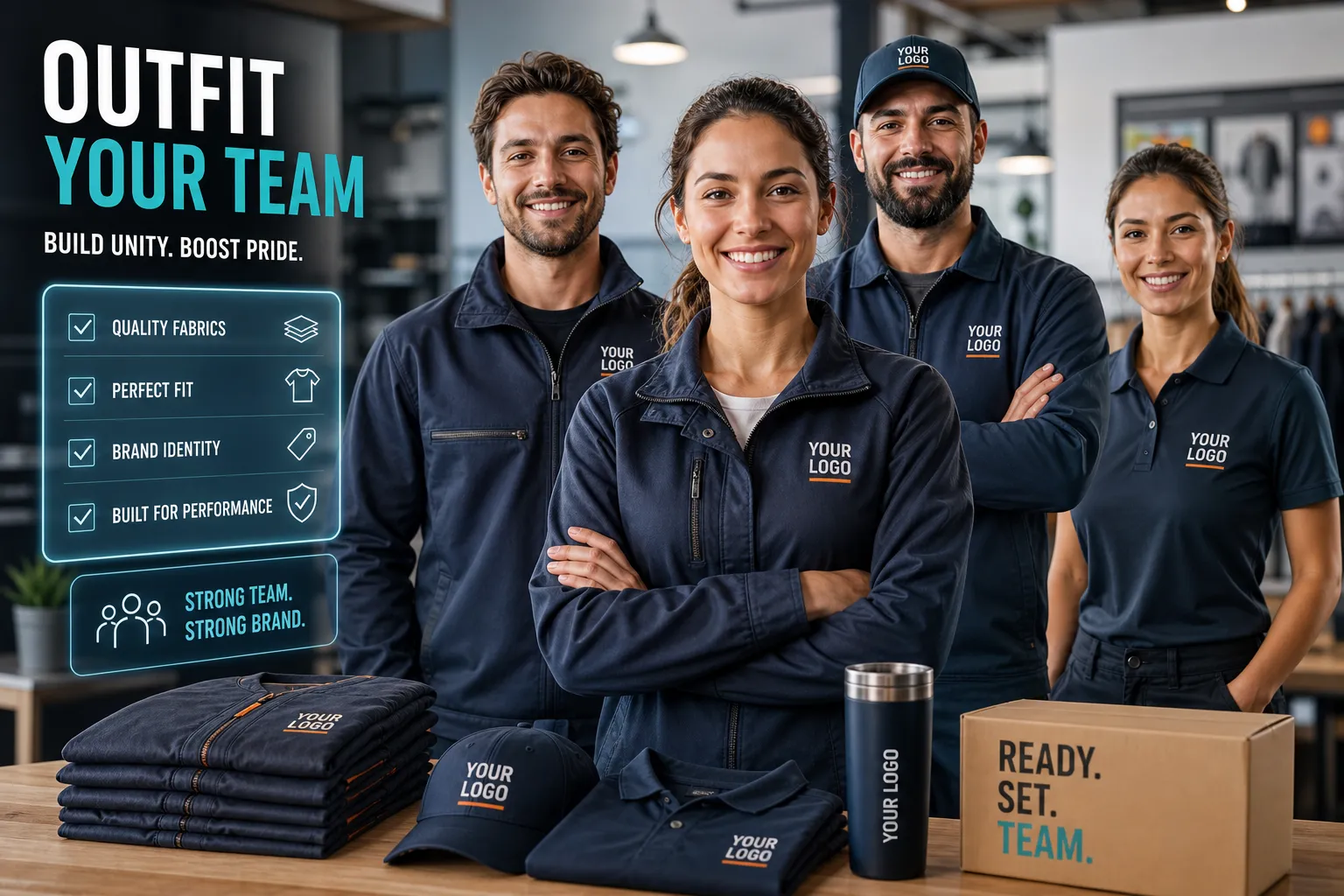
Branded workwear for teams is a straightforward concept until you actually have to order it. Many procurement managers understand the value, consistent brand presentation, staff professionalism, team cohesion, but stall on everything that follows: which fabric, which branding method, which sizes, which supplier, which compliance standard. Without clear answers, a workwear project can sit in someone’s inbox for weeks while a rollout deadline approaches. And when the order eventually goes out without proper planning, the results are predictable: poorly specified garments that shrink in early washes or lose logo integrity, and a handful of team members whose uniforms simply do not fit.
This guide gives you a clear path from brief to delivered order. It covers fabric selection by role, branding method trade-offs, safety compliance for outdoor and industrial teams, sizing across a mixed workforce, realistic cost benchmarks, and what to look for in a South African supplier. Companies that want it done properly, including those sourcing from brands like Barron and Altitude, regularly work with InkspireVisuals to manage the full order. By the end of this article, you will know exactly what to specify, how to brand it, and who to contact.
Choosing the right fabric for branded workwear for teams
Most buyers jump straight to logo placement and skip fabric selection entirely, and that is the decision that causes the most problems. Fabric choice is not about personal preference; it is about matching a garment’s technical properties to the demands of the job. The key benchmark to understand is GSM, or grams per square metre. GSM tells you how heavy and thick a fabric is, and it is the most reliable indicator of how a garment will perform under daily wear.
Hospitality and front-of-house roles
A 65/35 poly-cotton blend in the 160 to 220 GSM range is the standard choice for hospitality uniforms. It wrinkle-resists well, survives repeated machine washing, and maintains a polished appearance across long shifts. Guest-facing staff benefit from the lighter end of that range, around 160 to 180 GSM, for a refined look and feel. Housekeeping and service staff, who put garments through more physical stress, are better suited to 180 to 200 GSM, which holds its shape and handles frequent laundering without deteriorating quickly.
Fieldwork and outdoor crews
Ripstop and poly-cotton twill constructions are the right call for teams working in rough terrain, outdoor conditions, or with tools and equipment. Field shirts typically perform well at 150 to 190 GSM, while heavier fieldwork pants sit in the 190 to 240 GSM range; heavier-duty coveralls step up to 240 to 280 GSM. Ripstop is particularly valuable because the reinforced grid construction resists tearing at stress points, which matters when team members are constantly moving, crouching, or working with equipment that snags fabric.
Industrial and warehouse teams
65/35 poly-cotton twill is the reliable standard for industrial environments. It survives industrial laundering, resists shrinking, and holds its structure through long shifts in demanding conditions. Standard industrial uniforms sit comfortably at 190 to 260 GSM. Aprons, outerwear, or garments exposed to high abrasion benefit from the 240 to 300 GSM range, where the added fabric weight translates directly to longer garment life.
Branding methods for teams: embroidery vs. screen printing
Both methods produce professional results, but they suit different garments, logo types, and order sizes. Choosing the wrong method for the wrong application wastes budget and delivers results that look off-brand within months. The decision comes down to logo size, placement, quantity, and the garment itself.
When embroidery makes the most sense
Embroidery is the right choice for small, detailed logos on structured garments: polos, corporate shirts, caps, and jackets. It is durable, carries a premium look, and holds up exceptionally well through repeated washing. The trade-off is cost. Stitch count drives the price, so large logos or multiple placements become expensive quickly. A typical embroidered polo at 50 units will cost significantly more per piece than a screen-printed equivalent, partly because of the per-unit embroidery price, and partly because of the once-off digitisation setup fee, which typically runs between R150 and R500 depending on logo complexity. Confirm current pricing with your chosen supplier, as rates vary.
When screen printing wins on value
Screen printing is the cost-effective choice for large graphics, back prints, and orders of 50 units or more. At that quantity, screen printing can be roughly half the total cost of embroidery for the same garment and design, though the exact saving depends on colour count, logo size, and supplier rates. Designs with many colours add to setup costs because each colour requires a separate pass, but for bold single or two-colour logos, screen printing delivers sharp, durable results at a meaningfully lower unit price. For high-volume team uniform printing with large branding areas, it is almost always the right call.
Logo placement: chest, back, and sleeve
Left-chest placement is the most common position for corporate workwear and suits both embroidery and screen printing well. Back prints are almost always better suited to screen printing; embroidering a large back graphic is rarely cost-effective because the stitch count climbs sharply with size. Sleeve placements add cost under both methods since each location is treated as a separate decoration. Limit sleeve branding to situations where it genuinely adds value, such as safety logos or secondary brand elements, rather than including it by default.
Safety and compliance: what outdoor and industrial teams need to know
Branded PPE and safety clothing carries legal and reputational risk if the wrong garments are specified. This is not an area where close enough is acceptable. Procurement officers and site managers need compliant workwear that also carries the company logo, and those two requirements need to be met simultaneously.
South Africa’s applicable standards depend on the specific hazard rather than a blanket rule. SANS 50471, which aligns with ISO 20471, is the standard for high-visibility warning clothing and is the most relevant for teams working near traffic or in low-light conditions. It requires retroreflective tape at least 50 mm wide that encircles the relevant body area to provide 360-degree visibility. SANS 1423-1 applies to flame-retardant clothing, which is essential for teams exposed to heat, sparks, or flash fire risk.
SANS 434 covers general workwear and boilersuit construction. A risk assessment should always precede garment specification because compliance is driven by the specific hazard the team faces, not by a general rule about outdoor work.
The most common procurement mistake in this category is assuming that any reflective garment is automatically SANS 50471 compliant. It is not. Similarly, ordering flame-retardant-looking garments that carry no certifiable protection is a compliance and safety risk. Always request compliance documentation from your supplier before committing to a bulk PPE order. A reputable South African supplier will have the relevant compliance certificates on hand for any safety workwear they stock.
Sizing across a diverse team: how to avoid the most common order mistake
Sizing is where bulk workwear orders quietly go wrong. A 50-piece order where 10 garments do not fit is a direct waste of budget and creates exactly the kind of friction that branded uniforms are supposed to avoid. The good news is that this problem is almost entirely preventable with a bit of upfront planning.
A standard sizing guide from your supplier is a starting point, not a solution. Body measurements vary significantly across a workforce, especially when the team is mixed-gender or spans a wide age range. South African apparel research consistently identifies the following as recurring fit problems for women’s workwear: bust fit that is too tight, waist fit that is too loose, hip and thigh tightness in larger sizes, and trouser lengths that run long.
Many workwear garments are also derived from men’s base patterns without properly adjusting the bust, waist, hip, and shoulder proportions for women, which compounds the problem. Collect actual body measurements from staff using the supplier’s measurement guide before finalising the size breakdown, rather than relying on self-reported S, M, L, and XL preferences.
For orders above a certain threshold, request a pre-production fit sample before full production begins. This lets the team assess fabric quality and branding placement in person, and it catches sizing or fit issues before they are multiplied across the entire order. Many reputable suppliers offer this option, confirm availability with your supplier when requesting a quote. The short addition to your lead time is worth it to avoid costly reworks.
What bulk orders actually cost and how long they take
Here are the numbers you need to budget accurately and plan realistically. These are South African market benchmarks based on typical supplier pricing and should be treated as planning estimates rather than fixed quotes, since fabric upgrades, embroidery, and custom labels all push prices upward.
On lead times: standard production for a customised workwear order in South Africa typically runs 4 to 6 weeks, with delivery adding 1 to 5 working days after dispatch. Smaller runs under 50 units can sometimes be completed in 2 to 4 weeks. Branded sample requests usually take 2 to 7 working days once artwork is approved. Build a buffer of at least one week, more for complex decoration, international manufacture, or peak seasons, into any timeline with a fixed event or rollout date attached. Tight deadlines with no buffer are the single most common reason bulk orders land with problems that were entirely avoidable.
Finding the right corporate uniform supplier in South Africa
By this point, you know what you need. The final step is choosing a supplier who can deliver it reliably. The practical criteria are straightforward: clear MOQ structures with transparent pricing, in-house branding capabilities so the order is not handed off to a third party, access to recognised workwear brands, pre-production sample availability, and documented compliance for any safety garments. A supplier who handles branded PPE, embroidered polos, and screen-printed jackets under one roof saves you multiple vendor relationships and the coordination headaches that come with them.
InkspireVisuals stocks corporate clothing from South African brands including Barron and Altitude, commonly used in South African corporate workwear supply and noted for a wide size range suited to diverse workforces. With in-house branding and an extensive catalogue, InkspireVisuals is structured for exactly the kind of procurement this guide has been preparing you for. Whether the brief calls for embroidered front-of-house hospitality shirts or compliant hi-vis jackets for a field crew, the range covers it. Confirm current stock, SKU availability, and shipping terms directly with the team when you reach out for a quote.
Your next step: brief it properly and get it done
The key decisions: match fabric weight to the job, choose embroidery for structured corporate wear and screen printing for larger graphics and higher volumes, factor compliance standards into any PPE order, collect real measurements before finalising your size breakdown, and budget for a 4 to 6 week production window on standard orders.
Sourcing branded workwear for teams is a long-term investment in brand visibility and staff professionalism. A brief that covers fabric, branding method, compliance, sizing, and lead time gives your supplier everything needed to get the order right the first time. Getting the spec right from the start is what separates an order that works from one that wastes budget and causes headaches. Contact the InkspireVisuals team to get a quote, discuss your requirements, and start the process with a supplier who understands what South African businesses actually need from their branded workwear.